
Bourbon & Rye: The Complete Guide to America's legendary whiskey expressions
Part of our OPEN CURIOSITY series of in-depth posts that dive deep into essential topics.
Reading Time: 8 minutes

The Great American Divide
Walk into any whiskey bar, order a drink, and you'll inevitably hear it: "Bourbon or rye?"
It's one of those questions that seems simple on the surface but opens up a world of nuance. Both are distinctly American whiskeys with centuries of history, devoted followings, and more complexity than their straightforward names suggest. Yet they're fundamentally different spirits—different enough that choosing between them isn't just a matter of preference. It's about understanding what you actually want in your glass.
The difference isn't trivial. It's not like choosing between two sodas. It's the difference between two entirely different flavor philosophies, rooted in grain, tradition, and the bold American spirit of experimentation that Doc Swinson's was built on.
So let's dig in. Because understanding bourbon and rye isn't just about becoming a better whiskey drinker. It's about becoming curious about what makes these spirits tick.
What Makes Bourbon, Bourbon?
Here's what the law says: To be bourbon, a whiskey must be:
Produced in the United States (anywhere, not just Kentucky)
Made from a grain mixture that's at least 51% corn
Distilled to no more than 160 proof
Aged in new, charred oak barrels
Bottled at a minimum of 80 proof
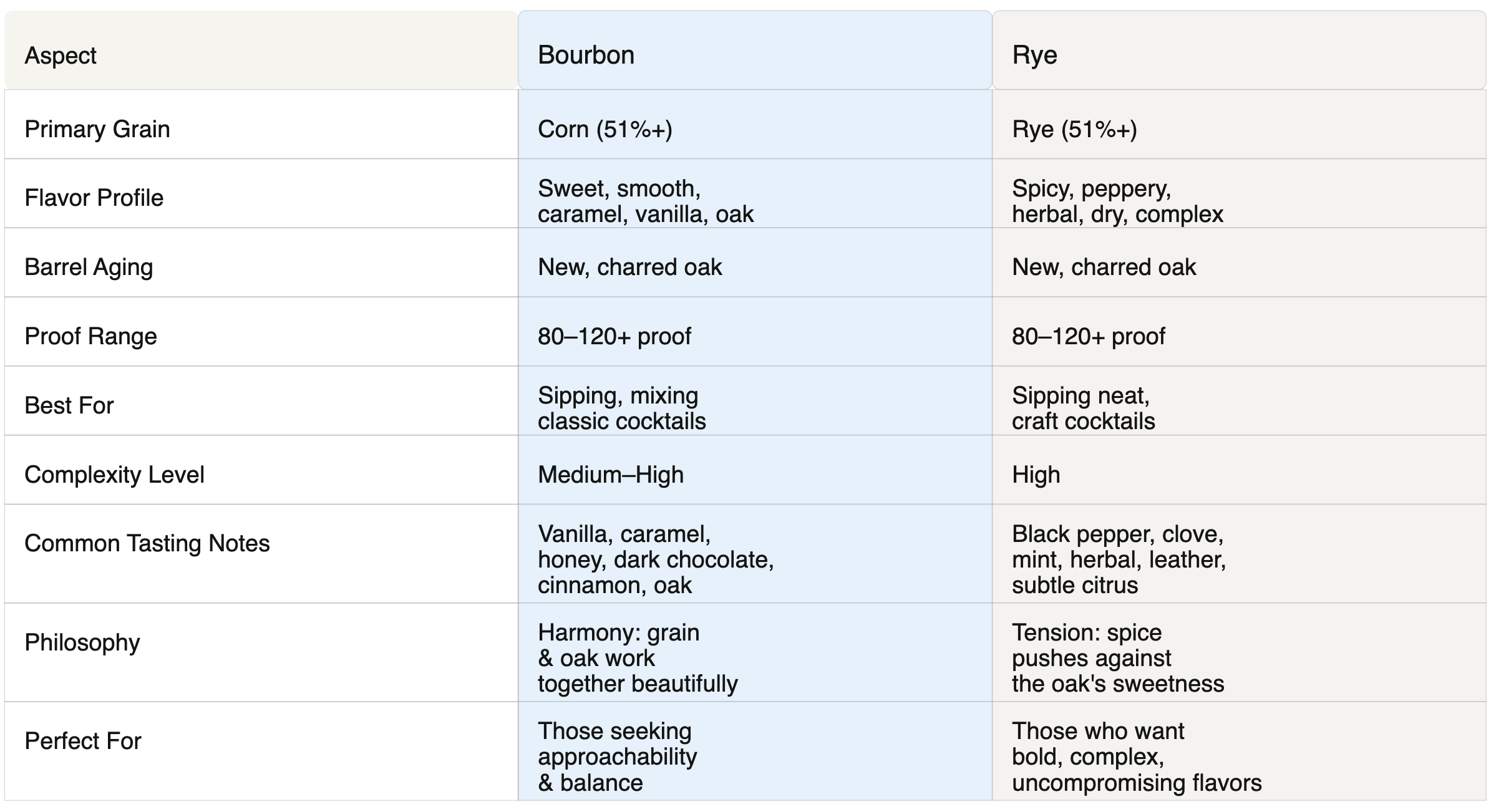
That 51% corn requirement is everything. Corn is sweeter than other grains—it brings vanilla, caramel, and honey notes naturally. When you age bourbon in those charred barrels, the heat of the char caramelizes the wood sugars, adding layers of sweetness, oak, and spice that blend with the corn's inherent character.
The result? Bourbon is the sweeter, softer cousin in this comparison. It's approachable. It's rich. It's the whiskey that makes you understand why America fell in love with whiskey in the first place.
Try it: Session Bourbon is a masterclass in what classic bourbon can be—a straight bourbon with a balance of sweetness and depth that makes it perfect for both newcomers and seasoned drinkers.
What Makes Rye, Rye?
Rye whiskey has a different set of rules—and a different soul.
To be rye, a whiskey must be:
Produced in the United States
Made from a grain mixture that's at least 51% rye
Distilled to no more than 160 proof
Aged in new, charred oak barrels (same as bourbon)
Bottled at a minimum of 80 proof
But here's where rye diverges. Rye grain is spicier, drier, and more assertive than corn. It brings black pepper, herbal notes, and a subtle earthiness that demands attention. Where bourbon invites you in with sweetness, rye challenges you to meet it on its own terms.
Rye also has a longer American history than many realize. Before bourbon dominated the landscape, rye was the whiskey of choice in the Northeast. It's bold. It's uncompromising. It's the whiskey for people who know what they want.
Try it: Bottled in Bond Rye represents rye at its finest—100 proof, fully matured, and unapologetically complex. Or explore our Solera Rye for a more experimental take on what rye can be.
The Real Difference: Grain Meets Character
This is where it gets interesting, because the difference between bourbon and rye isn't just technical. It's philosophical.
Bourbon is about harmony. The corn base wants to be sweet, and the barrel wants to add richness. They work together. Bourbon drinkers are often looking for a whiskey that feels complete—a spirit that tells a single, compelling story of wood and grain in conversation.
Rye is about tension. The rye grain's spiciness pushes against the oak's sweetness. They don't blend as smoothly; they dance. Rye drinkers are often those who appreciate complexity, who want to taste the grain's character asserting itself against time and oak.
Think of it this way: Bourbon is a classic American novel—beautiful, accessible, deeply satisfying. Rye is a poem—denser, more demanding, but incredibly rewarding if you sit with it.
Flavor Profiles: What You're Actually Tasting
Let's get specific, because this is where the real adventure begins.
Bourbon's Sweetness
When you nose a bourbon, you'll often smell vanilla, caramel, honey, and oak. On the palate, expect sweetness upfront—that corn character—followed by the barrel's influence: wood spice, chocolate, dried fruit. The finish is usually warm and lingering, with a slight sweetness that stays with you.
Common tasting notes include:
Vanilla and caramel
Honey and brown sugar
Dried fruit (raisin, apricot)
Cinnamon and oak
Dark chocolate
Rye's Complexity
Rye tastes different from the first nosing. You'll often find black pepper, clove, and a subtle mint or herbal character. On the palate, rye tends to be drier than bourbon, with more assertive spice. The finish is often peppery and lingering, sometimes with a slight bitterness that's actually appealing.
Common tasting notes include:
Black pepper and clove
Mint and anise
Cinnamon and ginger
Herbal notes (thyme, rosemary)
Oak and leather
Subtle citrus
What About Blended Grains?
Here's where it gets even more interesting: not all whiskeys are 51% corn or 51% rye. Many fall somewhere in between.
A bourbon might be 70% corn, 20% rye, and 10% malted barley. A rye might be 60% rye, 30% corn, and 10% malted barley. These percentages—called the mash bill—are what distillers use to fine-tune flavor.
More rye in a bourbon's mash bill? You get more spice and complexity alongside the sweetness. More corn in a rye's mash bill? You get more softness and approachability. This is where producers like Doc Swinson's get to be curious, to experiment, to push boundaries while respecting tradition.
Our Exploratory Collection embraces this philosophy. We take bourbon and rye as starting points and then ask: What if we finished this in rum casks? What if we blended unexpected barrels together? What if we challenged assumptions about what these whiskeys could be?
That's the spirit of curiosity—not clueless experimentation, but bold, informed exploration.
Cocktails: Where Bourbon and Rye Show Their True Colors
Here's a secret: bourbon and rye aren't just different spirits. They're different cocktail spirits.
Bourbon in Cocktails
Bourbon's sweetness makes it perfect for:
Old Fashioneds – The sweetness complements the bitters beautifully
Mint Juleps – Bourbon's vanilla notes play perfectly with mint
Manhattans – The richness pairs with vermouth without getting lost
Bourbon wants to be part of a conversation where it adds warmth and comfort.
Rye in Cocktails
Rye's spice and dryness make it ideal for:
Sazeracs – Rye's peppery character stands up to absinthe
Whiskey Smashes – The spice cuts through citrus and herbal notes
Craft cocktails – Bartenders love rye's ability to hold its own against bold ingredients
Rye wants to lead. It wants to be noticed.
The best bartenders—and we've worked with many—understand this instinctively. They don't choose bourbon or rye arbitrarily. They choose based on the story they want to tell with the drink.
We created our Curious Cocktails collection with this understanding. Each recipe is designed to let the whiskey shine in a way that respects its character.
How to Choose: It All Comes Down to You
So which should you drink?
The honest answer: It depends on what you're looking for in a whiskey experience.
Choose bourbon if you:
Are newer to whiskey and want something approachable yet complex
Prefer sweeter spirits
Love vanilla, caramel, and oak-forward flavors
Want a whiskey that's versatile in cocktails and exceptional neat
Appreciate balance and harmony in a glass
Choose rye if you:
Want bold, spicy, and unapologetic flavors
Appreciate herbal and peppery notes
Love complexity and aren't afraid of a whiskey that challenges you
Want something that stands out in a crowd
Prefer dry spirits that reward close attention
But here's the thing: you don't have to choose just one. The wisest whiskey drinkers keep both in their cabinet. They understand that bourbon and rye aren't competitors. They're two different languages for saying the same thing: This is American whiskey, and it's worth exploring.
The Doc Swinson's Approach: Respecting Tradition, Embracing Curiosity
At Doc Swinson's, we don't see bourbon and rye as opposing forces. We see them as two sides of the same coin—two distinct American traditions that deserve respect, understanding, and, yes, a bit of bold experimentation.
Our bourbon expressions like Session Bourbon and Triple Cask Bourbon honor what makes bourbon great: sweetness, approachability, and the magic of new charred oak. But we also push boundaries. We finish our rye whiskeys in rum casks, in tequila casks, in whatever cask will create something intriguing and wise—never surreptitious, never reckless.
That's the Doc Swinson's philosophy: Open Curiosity. We taste each barrel. We understand the rules so deeply that we can break them thoughtfully. We respect the tradition of bourbon and rye while asking: What if?
Where to Start Your Exploration
If you're just beginning to explore the bourbon vs. rye question, here's where we'd suggest starting:
Start with bourbon:Session Bourbon is approachable without being simple. It's the perfect introduction to what bourbon can be.
Then explore rye:Bottled in Bond Rye is unapologetic and complex. It's rye at full strength and full maturity.
Then get curious: Visit our Barrel Lab tasting room and taste them side by side. Let a knowledgeable guide walk you through the differences. Taste how bourbon's sweetness contrasts with rye's spice. Understand the difference not just intellectually but on your palate.
Then push further: Our Exploratory Collection exists for the moment when you're ready to question what you thought you knew about bourbon and rye. These are experiments in the best sense of the word—informed, intentional, and incredibly intriguing.
The Final Word
Bourbon and rye are different whiskeys for different moments, different moods, and different questions. Bourbon asks: How can we create harmony? Rye asks: How can we create complexity?
Neither is better. Neither is the "right" choice. The right choice is the one that matches what you're curious about today.
And if you're curious about both? Even better. That's the spirit of Open Curiosity—not choosing between bourbon and rye, but understanding what makes each one remarkable.
The question isn't bourbon or rye? The question is: What are you ready to explore?
Keep Exploring
Ready to taste the difference for yourself?
Visit our Barrel Lab tasting room – Book a guided tasting and discover your preference
Shop our collection – Browse all Doc Swinson's bourbon and rye expressions
Read more – Check out how barrel finishing works to understand another layer of whiskey complexity
Join our community – Sign up for Doc's Journal to stay updated on new releases and whiskey education
FAQs
Q: Is bourbon or rye more expensive?
A: Price varies by brand and expression, not by type. You can find affordable bourbons and expensive ryes, and vice versa. At Doc Swinson's, we focus on quality at every price point.
Q: Can you mix bourbon and rye together?
A: Absolutely. Many blended whiskeys and custom cocktails combine bourbon and rye. It's a great way to explore how they interact.
Q: What's the difference between bourbon and whiskey?
A: Bourbon is a type of whiskey—specifically, American whiskey made with at least 51% corn. All bourbon is whiskey, but not all whiskey is bourbon.
Q: Which is better for cocktails?
A: Both are excellent in cocktails, but they shine in different drinks. Bourbon works beautifully in Mint Juleps and Manhattans. Rye excels in Sazeracs and Whiskey Smashes.
Q: How should I drink bourbon vs. rye?
A: Both are best enjoyed neat or with a splash of water to open up the flavors. You can also enjoy them in your favorite cocktail. There's no "wrong" way to drink whiskey—only your way.